Post Top Ad

Propellerads
Showing posts with label Nature. Show all posts

Tuesday, May 9, 2017

4:56 AM

Indonesian man missing for 2 days, swallowed by a monstrous python! Must see!

Nature is really unpredictable, always. You'll never know what would happen next to you as you traverse in this world of wonderful things. In contrast with those wonderful things that surrounds us, there are also those sinister aspects that lurks in the corner. A good example of it is death. In this story, an Indonesian man named Akbar Salubiro who lives in the island of West Sulawesi. Did not returned after his work and had been missing for 2 days.
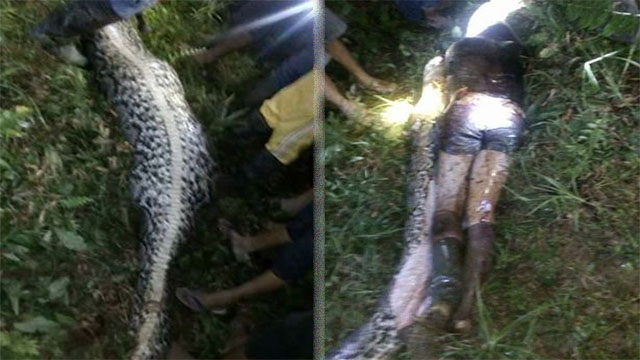
Of course his friends and relatives are so worried about him so they set up a search party to look for the missing Akbar. He's unseen for two days, who would not worry to person that can't be found anywhere for 2 days. As they searched the area they have found a bloated python near his back garden.

When one of Akbar's friend cut opened the snake's tummy, a horrible scene had been unveiled right before their very own eyes. Akbar, who is missing for 2 days has been found. The sad thing is, he is lifeless, inside of the monstrous python. Everything was recorded on camera and Akbar’s corpse can be clearly seen being slowly dragged out from the stomach of the Python. Watch the whole video below and don't forget to leave your comments.

SOURCES: MIRROR.CO.UK, YOUTUBE

Tuesday, April 25, 2017

4:34 AM

Horse savagely attacked an Alligator!

Yes, you are not mistaken of what you have just read. A seemingly peaceful day turned into an awesome surprise as a tourist from Florida captured a dramatic moment between a horse and a chilling alligator. The whole event was captured on camera by Krystal Berry on Wednesday near Gainesville, Florida.

The video that Krystal posted which includes the witnesses of the fateful event immediately caught the attention of the internet. The video had gone viral and reached millions of views in Youtube.

It has been awhile since I last saw such things in nature. I mean, I had been watching NatGeo and Animal Planet when I have the time, but these encounters commonly occurs in the wilds and not usually witnessed by many. This one above in the video is a great opportunity to us humans to watch how the animal kingdom do its own business.

In the full version of the footage you could clearly hear the concern of the people who were around during the event towards both animals. One of them says "Did he bite him?" so another replied "Just leave him alone." What a cruel person. Another one inquired, "Do you think he's OK?".

Berry and her friends was about to return to their cars when they noticed a group of horses enjoying their munchies of green green grass. They went to La Chua Trail at Paynes Praire and when they saw the group they decided to stop unwary of the things that would happen next in front of their naked eyes.

SOURCES: DAILYMAIL.CO.UK

Wednesday, April 19, 2017

2:07 AM

Rare videos of some animals before they extinct

The world was once abundant with a lot of animals, plants and other living organisms. Unfortunately, due to us, humans, who keep on damaging the eco-system and disrupting its balance, so many of these beings have already vanished and gone forever from this world. The damage has been done and now we can only see them through pictures, figurines and videos. Now, I wonder if how many more life on this planet would extinct before we fix everything. I think we should take good care of this planet before everything vanishes right before in front of our naked eyes. Now, below is a rare last videos of five animals before they have gone extinct from this planet. Watch it and see for yourself. Here are some of the the details regarding the first three animals in the video.
IVORY-BILLED WOODPECKER - The ivory-billed woodpecker (Campephilus principalis) is one of the largest woodpeckers in the world, at roughly 20 inches (51 cm) long and 30 inches (76 cm) in wingspan. It is native to the virgin forests of the Southeastern United States (along with a separate subspecies native to Cuba). Because of habitat destruction and, to a lesser extent, hunting, its numbers have dwindled to the point where whether any remain is uncertain, though reports have indicated it has been seen again in the current century. Almost no forests today can maintain an ivory-billed woodpecker population.
The species is listed as critically endangered and possibly extinct by the International Union for Conservation of Nature.[1] The American Birding Association (ABA) lists the ivory-billed woodpecker as a class 6 species, a category the ABA defines as "definitely or probably extinct"
THYLACINE - Thylacinus cynocephalus, Greek for "dog-headed pouched one") was the largest known carnivorous marsupial of modern times. It is commonly known as the Tasmanian tiger (because of its striped lower back) or the Tasmanian wolf.[7] Native to continental Australia, Tasmania and New Guinea, it is believed to have become extinct in the 20th century. It was the last extant member of its family, Thylacinidae; specimens of other members of the family have been found in the fossil record dating back to the late Oligocene.
Surviving evidence suggests that it was a relatively shy, nocturnal creature with the general appearance of a medium-to-large-size dog, except for its stiff tail and abdominal pouch (reminiscent of a kangaroo) and dark transverse stripes that radiated from the top of its back, similar to those of a tiger. The thylacine was an apex predator, like the tigers and wolves of the Northern Hemisphere from which it obtained two of its common names. As a marsupial, it was not closely related to these placental mammals, but because of convergent evolution it displayed the same general form and adaptations. Its closest living relative is thought to be either the Tasmanian devil or the numbat. The thylacine was one of only two marsupials to have a pouch in both sexes (the other being the water opossum). The male thylacine had a pouch that acted as a protective sheath, covering his external reproductive organs while he ran through thick brush. The thylacine has been described as a formidable predator because of its ability to survive and hunt prey in extremely sparsely populated areas.
The thylacine had become extremely rare or extinct on the Australian mainland before British settlement of the continent, but it survived on the island of Tasmania along with several other endemic species, including the Tasmanian devil. Intensive hunting encouraged by bounties is generally blamed for its extinction, but other contributing factors may have been disease, the introduction of dogs, and human encroachment into its habitat. Despite its official classification as extinct, sightings are still reported, though none has been conclusively proven.
HEATH HEN - a large North American bird in the grouse family, or possibly a distinct species, that became extinct in 1932. Heath hens lived in the scrubby heathland barrens of coastal North America from southernmost New Hampshire to northern Virginia in historical times, but possibly south to Florida prehistorically. The prairie chickens, Tympanuchus species, on the other hand, inhabited prairies from Texas north to Indiana and the Dakotas, and in earlier times in mid-southern Canada. Heath hens were extremely common in their habitat during Colonial times, but being a gallinaceous bird, they were hunted by settlers extensively for food. In fact, many have speculated that the Pilgrims' first Thanksgiving dinner featured heath hens and not wild turkey. By the late 18th century, the heath hen had a reputation as poor man's food for being so cheap and plentiful; somewhat earlier Thomas L. Winthrop had reported that they lived on the Boston Common (presumably when it was still used to graze cows, etc.) and that servants would sometimes bargain with a new employer for not being given heath hen for food more often than two or three days a week.